




















 Written by Jessie, Product Manager · Updated 11 November 2026
How much collagen should you take a day?
In a review of 11 skin trials, most gave 2.5 to 10 g of hydrolysed collagen a day for 8 to 24 weeks, and a meta-analysis found better hydration and elasticity than placebo. Two marine collagen trials used 5 g a day. Joint trials used 5 to 10 g, and a muscle study 15 g with strength training.
This article is for you if: you take collagen, or are thinking of starting, and want to know how many grams the research actually used, how long to take it for and where our collagen drinks fit.
Collagen powders and drinks come in very different serving sizes, so it's fair to wonder how much you really need. The clearest guide is what placebo-controlled trials gave people every day. Here's what they used for skin, joints and muscle, why the form of collagen matters as much as the grams, and how long to give it before you judge the results.
In this article
How much collagen do skin studies use?
Most trials in a systematic review of oral collagen for skin used 2.5 to 10 g of hydrolysed collagen a day, which is collagen broken down into short chains called peptides. The review covered 11 placebo-controlled trials with 805 people, and 8 of them used collagen hydrolysate at 2.5 to 10 g a day, for 8 to 24 weeks.[1] Two more used 3 g a day of collagen tripeptide and saw notable improvements in skin elasticity and hydration.[1]
A larger review and meta-analysis covered 19 randomised, double-blind trials with 1,125 people aged 20 to 70. Hydrolysed collagen improved skin hydration, elasticity and wrinkles compared with placebo, and the authors concluded that 90 days of use reduced signs of skin ageing.[2]
Marine collagen trials have used 5 g a day:
- Women after menopause. In 36 women, 5 g a day improved skin elasticity on the cheeks within 4 weeks compared with placebo.[3]
- Tuna collagen peptides. In 72 women, 5 g a day for 8 weeks raised skin hydration, elasticity and density more than placebo.[4]
Does the dose change with your goal?
Yes. Skin trials sit at the lower end of the range, while joint and muscle studies used 5 to 15 g a day. Here's what each trial gave every day.
| Goal | Study | Daily dose and length | Who took part | Result compared with placebo |
|---|---|---|---|---|
| Skin elasticity | Proksch et al., 2014 | 2.5 g or 5 g, 8 weeks | 69 women aged 35 to 55 | Better elasticity at both doses |
| Skin hydration and wrinkles | Kim et al., 2018 | 1 g of small collagen peptides, 12 weeks | 64 women aged 40 to 60 | Better hydration, wrinkles and elasticity |
| Skin elasticity | Sangsuwan and Asawanonda, 2021 | 5 g marine collagen, 4 weeks | 36 women after menopause | Better elasticity on the cheeks |
| Skin hydration, elasticity and density | Morakul et al., 2024 | 5 g tuna collagen, 8 weeks | 72 women | All three improved |
| Knee comfort during sport | Zdzieblik et al., 2017 | 5 g, 12 weeks | 139 active adults with knee pain during sport | Less pain during activity |
| Joint comfort | Clark et al., 2008 | 10 g, 24 weeks | 147 athletes (97 analysed) | Less joint pain when walking, standing, carrying and lifting |
| Muscle, with strength training | Zdzieblik et al., 2015 | 15 g, 12 weeks | 53 men aged about 72 with low muscle mass | More lean mass and leg strength |
Sources: the placebo-controlled trials listed in the References.[3] [4] [5] [6] [7] [8] [9]
Is more collagen always better?
Not necessarily: lower doses improved skin too. In one trial, 2.5 g and 5 g a day both improved skin elasticity compared with placebo after 8 weeks.[5] In another, 1 g a day of a low-molecular-weight collagen peptide (one made of especially small pieces) improved hydration, wrinkles and elasticity over 12 weeks.[6]
So the number of grams isn't the whole story:
- The form matters. Small collagen peptides showed results at 1 to 3 g a day.[6] [1] In the same review, one study suggested that the anti-ageing effect rose with the amount of collagen dipeptide (collagen in pairs of amino acids) in the product.[1]
- The habit matters. Every trial in the table gave collagen every single day.
Our view is simple. Pick a dose inside the studied range that you'll happily take every day, and check the collagen in mg per serving on the label, rather than the weight of the scoop or sachet.
How long should you take collagen for?
Plan on at least 8 weeks of daily use before you judge your skin, since the hydrolysed collagen skin trials in one review ran for 8 to 24 weeks.[1] Some changes come sooner: skin elasticity improved within 4 weeks at 5 g a day in one marine collagen trial.[3]
Taking it at the same time each day makes the habit easier to keep. For a week-by-week view of what changes when, see how long collagen actually takes to work.
Where do our collagen drinks fit?
Both of our marine collagens sit inside the range the skin trials used.
- Collagen Glow Berries gives you 6,000 mg of Wellnex™ marine collagen dipeptides (Types I and III) in every ready-to-drink sachet, with 250 mg of vitamin C, a co-factor for the enzymes that stabilise the collagen molecule.[10] There's nothing to mix, which makes the daily habit easy at home, at work or when you travel. Take 1 sachet a day, before breakfast or at bedtime.
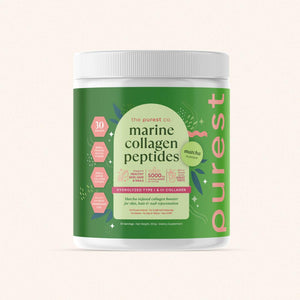
- If you'd rather stir a powder into water, our Marine Collagen Peptides gives you 5,000 mg (5 g) of hydrolysed collagen from wild Norwegian cod in every scoop, the same daily amount used in the two marine collagen trials in this article.
For what else to check on a label, read our guide to choosing good marine collagen peptides.
90-day money back guarantee
Related reading: How long does collagen actually take to work? · How do you choose good marine collagen peptides? · Does drinking hyaluronic acid work for skin?
Frequently asked questions
Is 10 g of collagen a day too much?
No. Ten grams is the top of the range used in skin trials, and athletes took 10 g a day for 24 weeks in one joint study. A review of 11 trials found collagen supplements generally safe, with no reported adverse events. Collagen counts as protein, so if you've been told to limit protein, check with your doctor first.
What happens if I stop taking collagen?
In two trials, the skin gains held for a while after people stopped. Elasticity was still better than placebo 4 weeks after a 5 g marine collagen course ended, and the gains from tuna collagen were largely kept 2 weeks after stopping. To keep the benefits going, keep up the daily habit.
Should I take vitamin C with collagen?
It helps to get enough. Vitamin C is a co-factor for the enzymes that stabilise the collagen molecule, and it also promotes collagen gene activity. You don't need to take them at the exact same moment. What counts is getting enough vitamin C across your day.
Can I take collagen if I'm pregnant or allergic to fish?
Marine collagen comes from fish, so skip it if you have a fish allergy. If you're pregnant, breastfeeding, taking medication or have a health condition, check with your doctor before you start any collagen supplement.
Key takeaways
- In a review of 11 skin trials, most gave 2.5 to 10 g of hydrolysed collagen a day for 8 to 24 weeks, and a meta-analysis of 19 trials found better hydration and elasticity than placebo.
- Two marine collagen trials used 5 g a day and saw better skin elasticity within 4 to 8 weeks.
- Joint studies used 5 to 10 g a day, and a muscle study used 15 g alongside strength training.
- The form and the habit matter as much as the grams: small peptides worked at 1 to 3 g, and every trial in the table gave collagen daily.
- Collagen Glow Berries (6,000 mg) and Marine Collagen Peptides (5,000 mg) both sit inside the range studied for skin.

About the author: Jessie is the Product Manager at The Purest Co. A Biomedical Science graduate from the International Medical University Malaysia, she has over five years in the nutraceutical industry, sourcing high-quality herbs to create supplements that are enjoyable and effective. She keeps up with new research through global conferences.
References
[1] Choi FD, Sung CT, Juhasz ML, Mesinkovsk NA. Oral collagen supplementation: a systematic review of dermatological applications. J Drugs Dermatol. 2019.
[2] de Miranda RB, Weimer P, Rossi RC. Effects of hydrolyzed collagen supplementation on skin aging: a systematic review and meta-analysis. Int J Dermatol. 2021.
[3] Sangsuwan W, Asawanonda P. Four-weeks daily intake of oral collagen hydrolysate results in improved skin elasticity, especially in sun-exposed areas: a randomized, double-blind, placebo-controlled trial. J Dermatolog Treat. 2021.
[4] Morakul B et al. The evidence from in vitro primary fibroblasts and a randomized, double-blind, placebo-controlled clinical trial of tuna collagen peptides intake on skin health. J Cosmet Dermatol. 2024.
[5] Proksch E et al. Oral supplementation of specific collagen peptides has beneficial effects on human skin physiology: a double-blind, placebo-controlled study. Skin Pharmacol Physiol. 2014.
[6] Kim DU et al. Oral intake of low-molecular-weight collagen peptide improves hydration, elasticity, and wrinkling in human skin: a randomized, double-blind, placebo-controlled study. Nutrients. 2018.
[7] Zdzieblik D, Oesser S, Gollhofer A, König D. Improvement of activity-related knee joint discomfort following supplementation of specific collagen peptides. Appl Physiol Nutr Metab. 2017.
[8] Clark KL et al. 24-week study on the use of collagen hydrolysate as a dietary supplement in athletes with activity-related joint pain. Curr Med Res Opin. 2008.
[9] Zdzieblik D et al. Collagen peptide supplementation in combination with resistance training improves body composition and increases muscle strength in elderly sarcopenic men: a randomised controlled trial. Br J Nutr. 2015.
[10] Pullar JM, Carr AC, Vissers MCM. The roles of vitamin C in skin health. Nutrients. 2017.
These statements have not been evaluated by any regulatory authority. This product is not intended to diagnose, treat, cure, or prevent any disease. Individual results may vary. Consult a healthcare provider before use if you are pregnant, breastfeeding, or on prescribed medication.