














 Written by Esther, Production Manager · Updated 21 October 2026
Do collagen drinks absorb better than capsules?
Hydrolysed collagen peptides are absorbed the same way whether you drink, stir or swallow them. What decides your results is the dose: skin trials used 2.5 to 10 g a day, taken every day. A collagen drink or powder can give you a trial-level dose in one serving. With capsules, check how many make up that amount.
This article is for you if: you're choosing between a collagen drink, powder, capsules or gummies, and want to know which one your body absorbs best and how to get a dose that matches the research.
Collagen now comes as sachets, powders, capsules and gummies, and it's easy to assume one of them must absorb better than the rest. In supplement production, though, the format is the last step. How well collagen absorbs is set earlier, when it is hydrolysed into peptides, and what it can do for your skin depends on how much you take each day. Here's how the formats compare, and what to check on the label.
→ See Collagen Glow Berries, our marine collagen drink
In this article
How does your body absorb collagen from a drink, powder or capsule?
Your gut absorbs hydrolysed collagen peptides the same way, whichever format they come in. A drink arrives already dissolved, a powder dissolves when you stir it, and a capsule opens once you swallow it. From there, the peptides take the same path into your blood.
- The collagen is already cut small. Hydrolysed collagen is collagen broken into peptides of about 3 to 6 kDa (kilodaltons, a measure of molecular size), down from about 285 to 300 kDa for whole collagen.[1]
- Collagen peptides reach your blood within hours. In healthy volunteers who took hydrolysed collagen after a 12-hour fast, collagen peptides in the blood peaked 1 to 2 hours later. The main one was Pro-Hyp (prolyl-hydroxyproline), a dipeptide, which means a peptide just two amino acids long.[2]
- Several collagen peptides arrive together. A later study measured nine collagen peptides in human blood after hydrolysed collagen, at substantially higher levels than seen after other food peptides.[3]
So the format is the carrier, not the deciding factor. To see what these peptides do once they reach your skin, read do collagen drinks actually work? For the very first step of the journey, see our guide to whether collagen survives stomach acid.
What decides how well collagen is absorbed?
Hydrolysis decides it. This is the production step that cuts collagen into peptides, and the smaller and more thoroughly hydrolysed the peptides are, the faster they reach your blood.
Hydrolysis happens long before collagen is filled into a sachet, a tub or a capsule. Enzymes such as alcalase, papain or pepsin cut the collagen chains, and the type and degree of hydrolysis shape the peptides' size, how well they dissolve and their bioavailability, which is how much reaches your blood.[1] Here is what absorption studies found:
- Further hydrolysis, faster uptake: in a randomised crossover trial with 10 healthy men, collagen given an extra enzymatic hydrolysis step raised blood glycine, proline and hydroxyproline faster, and with higher bioavailability, than the same collagen without it.[4]
- Smaller peptides, earlier peak: in a 2026 study in 15 healthy men, collagen of about 500 daltons, with over 45% di- and tripeptides, brought blood glycine and proline to their peak at 30 minutes, compared with 120 minutes for a standard collagen of 2,000 to 3,000 daltons.[5]
- Every hydrolysed source gets in: in a 2024 crossover trial, hydrolysed collagen from fish, pig and cow, at 2,000 and 5,000 daltons, all gave meaningful blood levels of hydroxyproline and collagen peptides.[6]
- The source shapes the peptide mix: in a crossover study, fish scale collagen produced more hydroxyproline-containing peptides in the blood than pig skin collagen, and some peptides appeared only after fish collagen.[7]
- Dipeptides matter for skin: in a randomised, placebo-controlled trial, collagen with more of the dipeptides Pro-Hyp and Hyp-Gly improved facial skin moisture, elasticity, wrinkles and roughness more than collagen with less.[8]
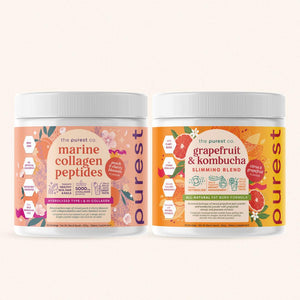
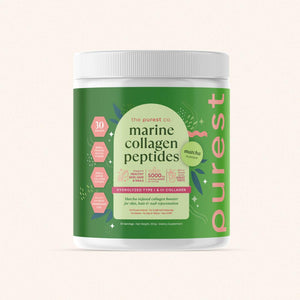
That's why the collagen itself matters more than the format it ends up in. Collagen Glow Berries uses Wellnex marine collagen dipeptide: hydrolysed Types I and III collagen from tilapia, made by enzymatic hydrolysis. Its glycine, proline and hydroxyproline come in a 3:1:1 ratio, which reflects collagen's own structure, where every third amino acid is glycine and Pro-Hyp-Gly is the most common building block.[9] Marine Collagen Peptides uses collagen peptides from wild-caught cod, hydrolysed to an average molecular size under 3 kDa, smaller than the 3 to 6 kDa typical of hydrolysed collagen.[1]
How much collagen do you get from a drink, powder, capsule or gummy?
A ready-to-drink sachet or a scoop of powder can hold a trial-level dose in one serving. With capsules and gummies, check the label for the collagen in each piece, and how many pieces make up a serving.
Skin trials used 2.5 to 10 g of collagen hydrolysate a day, for 8 to 24 weeks.[10] Compare products by the collagen in each serving, and remember that 1,000 mg is 1 g.
| Format | Collagen per serving | Servings for 2.5 to 10 g | Convenience | What to check on the label |
|---|---|---|---|---|
| Ready-to-drink sachet | Set by the sachet. Collagen Glow Berries: 6,000 mg | 1 sachet, when it holds 2,500 mg or more | Tear and drink, with no water or mixing | Collagen in mg per sachet, the form (peptides or dipeptide), vitamin C, sugar |
| Powder | Set by the scoop. Marine Collagen Peptides: 5,000 mg per 10 g scoop | 1 scoop, when it holds 2,500 mg or more | Stir into water or another drink | Collagen in mg per scoop, flavour, how easily it dissolves |
| Capsules or tablets | Check the label for mg per capsule | Divide your target dose by the mg per capsule | Swallow with water, no taste, easy to travel with | Collagen in mg per capsule, capsules per serving, total collagen per serving |
| Gummies | Check the label for mg per gummy | Divide your target dose by the mg per gummy | Chew, with no water needed | Collagen in mg per gummy, sugar per serving |
Trial dose range: systematic review of randomised, placebo-controlled trials.[10] Product amounts: The Purest Co product information.
To work out how many capsules or gummies you need, divide the dose you're aiming for by the collagen in each one. For example, to reach 5,000 mg, divide 5,000 by the mg per capsule on the label. For a full label checklist, from collagen type to sugar and allergens, see our guide to choosing the right type of collagen.
Which collagen format fits your day?
The best format is the one you'll take every day at a trial-level dose. Skin trials gave collagen daily for 8 weeks or more,[10] so choose the one that fits most easily into your routine.
- Ready-to-drink sachet: nothing to mix and no water needed. Keep one in your bag for the MRT or in your desk drawer at the office.
- Powder: stir a scoop into water, or into your morning coffee. In a 2025 crossover trial, collagen peptides such as Pro-Hyp and Hyp-Gly reached the blood at similar levels whether the collagen was dissolved in coffee or in water.[11]
- Capsules or tablets: no taste, and easy to pack for a trip. They suit you if you're happy to take the number of capsules a full dose needs.
- Gummies: sweet and easy to chew. Check the collagen and the sugar in each gummy.
If you'd like your full dose in one step, Collagen Glow Berries is a ready-to-drink sachet with 6,000 mg of Wellnex marine collagen dipeptide, within the 2.5 to 10 g range used in skin trials.[10] Each sachet also has 250 mg of vitamin C, which your skin uses to make its own collagen,[12] and 100 mg of bilberry extract. Take 1 sachet a day, in the morning before breakfast or before bed, with no water needed. It contains fish, so skip it if you have a fish allergy.
If you'd rather mix your own, Marine Collagen Peptides gives you 5,000 mg of marine collagen peptides in each 10 g scoop, with 50 mg of water bamboo extract and 10 mg of beta-carotene, in a peach and cherry blossom flavour. Stir 1 scoop into a glass of water once a day, before breakfast or before bed. It also contains fish.
90-day money back guarantee
Related reading: Do collagen drinks actually work? · Which type of collagen is best for you? · Where our marine collagen comes from
Frequently asked questions
Do you need vitamin C to absorb collagen?
Collagen peptides are absorbed on their own, so vitamin C isn't needed for that step. It helps at the next one: your skin uses vitamin C to make its own collagen. That's why collagen and vitamin C are so often paired, and Collagen Glow Berries has 250 mg of vitamin C in every sachet.
Is marine collagen absorbed better than bovine collagen?
Both are absorbed well when they're hydrolysed. In a 2024 crossover trial, hydrolysed collagen from fish, pig and cow all gave meaningful blood levels of collagen peptides. The exact mix of peptides depends on the source, and fish collagen produced some peptides not seen with pig collagen. Marine collagen also suits people who avoid beef or pork.
Is collagen absorbed better on an empty stomach?
In absorption studies, people took collagen after a 12-hour fast, and collagen peptides peaked in their blood 1 to 2 hours later. Collagen Glow Berries is best taken on an empty stomach, in the morning before breakfast or before bed. Taking it every day matters most, so pick a time you'll remember.
Can you take a collagen drink and collagen capsules on the same day?
Yes. Add up the collagen from each product so you know your daily total, and compare it with the 2.5 to 10 g a day used in skin trials. One product at a trial-level dose is usually the simplest routine to keep up. If you're pregnant, breastfeeding, on medication or have allergies, check with your doctor first.
Key takeaways
- Your gut absorbs hydrolysed collagen peptides the same way from a drink, powder, capsule or gummy.
- Collagen peptides such as Pro-Hyp peak in the blood 1 to 2 hours after a dose.
- Hydrolysis decides absorption: smaller, more thoroughly hydrolysed peptides reach the blood faster.
- Skin trials used 2.5 to 10 g a day. A sachet or scoop can give you that in one serving; with capsules and gummies, check the label.
- The best format is the one you'll take every day.

About the author: Esther is the Production Manager at The Purest Co. A biotechnology graduate from Monash University, she has experience in nutraceutical manufacturing and quality assurance, and oversees day-to-day production with a QA-driven approach to quality control, documentation and regulatory compliance.
References
[1] León-López A et al. Hydrolyzed collagen: sources and applications. Molecules. 2019.
[2] Iwai K et al. Identification of food-derived collagen peptides in human blood after oral ingestion of gelatin hydrolysates. J Agric Food Chem. 2005.
[3] Ichikawa S et al. Hydroxyproline-containing dipeptides and tripeptides quantified at high concentration in human blood after oral administration of gelatin hydrolysate. Int J Food Sci Nutr. 2010.
[4] Skov K et al. Enzymatic hydrolysis of a collagen hydrolysate enhances postprandial absorption rate: a randomized controlled trial. Nutrients. 2019.
[5] Nergiz-Unal R et al. Enhanced digestion and absorption kinetics of ultra-low molecular weight collagen containing di- and tripeptides: evidence from human and cell models. PeerJ. 2026.
[6] Virgilio N et al. Absorption of bioactive peptides following collagen hydrolysate intake: a randomized, double-blind crossover study in healthy individuals. Front Nutr. 2024.
[7] Ohara H et al. Comparison of quantity and structures of hydroxyproline-containing peptides in human blood after oral ingestion of gelatin hydrolysates from different sources. J Agric Food Chem. 2007.
[8] Inoue N et al. Ingestion of bioactive collagen hydrolysates enhance facial skin moisture and elasticity and reduce facial ageing signs in a randomised double-blind placebo-controlled clinical study. J Sci Food Agric. 2016.
[9] Shoulders MD, Raines RT. Collagen structure and stability. Annu Rev Biochem. 2009.
[10] Choi FD et al. Oral collagen supplementation: a systematic review of dermatological applications. J Drugs Dermatol. 2019.
[11] Virgilio N et al. Unravelling the bioavailability of amino acids and bioactive peptides from collagen hydrolysate in coffee in healthy volunteers. Food Res Int. 2025.
[12] Pullar JM et al. The roles of vitamin C in skin health. Nutrients. 2017.
These statements have not been evaluated by any regulatory authority. This product is not intended to diagnose, treat, cure, or prevent any disease. Individual results may vary. Consult a healthcare provider before use if you are pregnant, breastfeeding, or on prescribed medication.