

















 Written by Jessie, Product Manager · Updated 19 October 2026
Which type of collagen is best for you?
For more elastic, better-hydrated skin, choose hydrolysed collagen peptides with Types I and III, the form used in most skin trials, at 2.5 to 10 g a day. For joints, both Type II collagen and collagen peptides have been studied. Then pick the source that suits you: marine (fish), bovine or chicken, halal-certified if you need it.
This article is for you if: you're choosing a collagen supplement for your skin, joints or nails, and want to know which type, source and format to pick, and what to check on the label.
Collagen gives structure to your skin, bones, tendons and cartilage, and Type I alone makes up over 90% of the collagen in your body.[1] Your skin makes less Type I and Type III collagen as you age,[2] which is why so many people add a collagen supplement to their day. With fish, beef and chicken collagen sold as drinks, powders and capsules, choosing one can feel confusing. This guide sorts the options by what you want collagen to do for you.
→ See Collagen Glow Berries, our marine collagen drink
In this article
- What are the main types of collagen, and what is each for?
- What can collagen do for your skin, joints, nails and bones?
- Where does the collagen in supplements come from?
- Hydrolysed, dipeptide, undenatured or gelatin: which form should you choose?
- Drink, powder, capsules or gummies: which format suits you?
- How much collagen should you take a day?
- What should you check on a collagen label?
- Which Purest Co collagen fits which goal?
- Frequently asked questions
What are the main types of collagen, and what is each for?
Scientists have identified at least 28 types of collagen, but three matter most when you choose a supplement: Types I, II and III.[1] Each type sits in different parts of the body, so the type on a label tells you what a product is designed to support.[3]
| Type | Where it's found in your body | Usually chosen for |
|---|---|---|
| Type I | Skin, bone, teeth, tendons, ligaments and organs. Over 90% of your body's collagen | Skin, nails and bones |
| Type II | Cartilage, the cushioning in your joints | Joints |
| Type III | Skin, muscle and blood vessels, alongside Type I | Skin, paired with Type I |
Where each type is found: StatPearls and a review of collagen sources.[1] [3]
Your skin's collagen is mainly Types I and III, and ageing skin makes less of both.[2] [3] That's why skin-focused supplements usually list Type I, or Types I and III together, while joint formulas often list Type II.
What can collagen do for your skin, joints, nails and bones?
Clinical trials show that daily collagen peptides support skin hydration, elasticity and collagen density, with encouraging results for joints, nails and bones too. Whether your skin feels tight after a day in air-conditioning or you want to keep active, here's what the research found.
Skin
- A 2021 meta-analysis of 19 randomised, double-blind trials, with 1,125 people aged 20 to 70, found that hydrolysed collagen improved skin hydration, elasticity and wrinkles compared with placebo, after about 90 days of use.[4]
- In placebo-controlled trials, collagen peptides increased collagen density in the dermis, the deeper layer of skin, after 4 weeks, and improved skin hydration after 8 weeks.[5]
- In 114 women aged 45 to 65, 2.5 g of collagen peptides a day for 8 weeks reduced eye wrinkle volume by 20% compared with placebo. Their skin also held 65% more procollagen type I, the building block of new collagen, and 18% more elastin.[6]
Joints
- In a 24-week trial with 147 athletes who had activity-related joint pain, 10 g of collagen hydrolysate a day reduced joint pain when walking, standing and at rest compared with placebo.[7]
- In 139 young athletes with knee discomfort during sport, 5 g of collagen peptides a day for 12 weeks significantly improved activity-related knee pain compared with placebo.[8] There's more on this in our guide to collagen for joints.
Nails
- In a 24-week study of 25 people with brittle nails, 2.5 g of collagen peptides a day increased nail growth by 12% and cut the frequency of broken nails by 42%.[9]
Bones
- In 131 postmenopausal women with age-related lower bone density, 5 g of collagen peptides a day for 12 months increased bone mineral density in the spine and the top of the thigh bone compared with placebo, with a shift in bone markers towards more bone formation.[10]
Where does the collagen in supplements come from?
Collagen supplements are made from animals, mainly fish, cows, pigs and chickens.[3] The source sets the main collagen type, and it decides whether a product fits your diet, allergies and halal needs.
- Marine (fish) collagen comes from fish skin, scales and bones, including by-products of fish processing.[3] Fish skin is a common source of Type I collagen, and fish carries no religious restrictions.[11] In a study of 41 adults, 2 months of fish skin collagen peptides with plant antioxidants improved skin elasticity and ultrasound measures of the dermis.[12] Our own marine collagen comes from tilapia (in Collagen Glow Berries) and wild-caught North Atlantic cod (in Marine Collagen Peptides).
- Bovine (cow) collagen comes from hides, bones and tendons, and cows are a main source of Type I collagen.[3] It suits people who avoid fish.
- Porcine (pig) collagen comes mainly from pig skin.[3] The Islamic Religious Council of Singapore (MUIS) lists pork as non-halal.[13]
- Chicken collagen comes from skin, feet and cartilage. Chicken sternum (breastbone) cartilage is the source of the undenatured Type II collagen used in joint research.[3] [14]
| Source | Made from | Main collagen type | Typical use | Halal and allergens |
|---|---|---|---|---|
| Marine (fish) | Fish skin, scales and bones | Type I (some products also list Type III) | Skin, nails and bones | Contains fish. No religious restrictions on fish; look for halal certification |
| Bovine (cow) | Hides, bones and tendons | Type I | Skin, nails and bones | Halal only when certified. Not for people who avoid beef |
| Porcine (pig) | Pig skin | Type I | Skin, nails and bones | Not halal |
| Chicken | Cartilage, skin and feet | Type II (from cartilage) | Joints | Halal only when certified |
Sources and types: reviews of collagen sources and a Type II collagen trial.[3] [11] [14] Halal: MUIS.[13]
"Plant collagen" is not collagen. Plants don't make collagen, so these products supply nutrients such as vitamin C that help your body make its own. We explain the difference in marine collagen vs plant collagen.
Hydrolysed, dipeptide, undenatured or gelatin: which form should you choose?
For skin, choose hydrolysed collagen peptides, because that's the form most skin trials used. In a review of 11 randomised trials with 805 people, 8 used collagen hydrolysate at 2.5 to 10 g a day, 2 used collagen tripeptide and 1 used collagen dipeptide.[15]
- Hydrolysed collagen peptides: collagen broken down by enzymes into small peptides, about 3 to 6 kDa (a measure of molecular size), which dissolve easily in water.[3] This is the form behind the skin results above.[4]
- Collagen dipeptides: the smallest pieces, just two amino acids long. After people take collagen hydrolysate, the dipeptide prolyl-hydroxyproline (Pro-Hyp) is the main collagen peptide found in the blood.[16] In a placebo-controlled trial, a collagen hydrolysate richer in the dipeptides Pro-Hyp and Hyp-Gly improved skin moisture, elasticity, wrinkles and roughness more than one with less of them.[17]
- Undenatured Type II collagen: keeps its original structure and is taken in tiny amounts. In a 180-day trial with 191 adults with knee osteoarthritis, 40 mg a day of undenatured Type II collagen from chicken sternum cartilage improved joint pain, stiffness and function scores compared with placebo.[14]
- Gelatin: collagen that has been cooked and partly broken down. It's why a chilled bone soup turns to jelly. Hydrolysed collagen is broken down further, into smaller peptides that dissolve easily in water.[3]
Drink, powder, capsules or gummies: which format suits you?
The best format is the one you'll take every day at a dose close to the trials, which used 2.5 to 10 g of collagen a day.[15] The format changes how you take it, how much collagen fits in one serving and what comes with it, such as vitamin C or sugar.
| Format | How you take it | Suits you if | What to check |
|---|---|---|---|
| Ready-to-drink | Tear open a sachet or bottle and drink, no water or mixing | You want the simplest daily habit, at home or on the go | Collagen in mg per serving, vitamin C, sugar |
| Powder | Stir a scoop into water or another drink | You like to mix collagen into your own drinks | Collagen in mg per scoop, flavour, how easily it dissolves |
| Capsules or tablets | Swallow with water | You prefer no taste at all | How many capsules make one serving, and the total mg across them |
| Gummies | Chew | You like something sweet to chew | Collagen in mg per gummy, and sugar |
Trial dose range: systematic review of randomised trials.[15]
Because trial doses are measured in grams, a single drink or scoop is an easy way to reach them. For a closer look at absorption, read collagen drink vs capsules: which absorbs better?
How much collagen should you take a day?
Aim for 2.5 to 10 g of hydrolysed collagen a day (2,500 to 10,000 mg), the range used in skin trials, for at least 8 weeks.[15] Here's what trials used for each goal:
- Skin: 2.5 g and 5 g a day both improved skin elasticity within 8 weeks in women aged 35 to 55.[18]
- Joints: 5 to 10 g a day of collagen peptides in active adults.[7] [8]
- Nails: 2.5 g a day for 24 weeks.[9]
- Undenatured Type II: a different case, studied at 40 mg a day.[14]
If a label lists collagen in milligrams, divide by 1,000 to get grams: 6,000 mg is 6 g.
What should you check on a collagen label?
Check eight things: the dose, type, source and form of the collagen, then vitamin C, sugar, halal certification and allergens.
- Collagen dose in mg per serving. Compare it with the 2.5 to 10 g a day used in trials.[15] If collagen sits inside a "proprietary blend", the exact amount may not be shown.
- Collagen type. Types I and III for skin, Type II for joints.[3]
- Source. Marine, bovine, porcine or chicken, so you can match it to your diet and allergies.
- Form. For skin, look for "hydrolysed collagen", "collagen peptides" or "dipeptides".[15]
- Vitamin C. Your body needs vitamin C to build collagen,[1] and it stimulates collagen production in the skin.[19] A collagen drink with vitamin C, sometimes called a collagen C drink, gives you both in one serving.
- Sugar per serving. Drinks and gummies need flavour, so check total and added sugars on the nutrition panel.
- Halal certification, if you need it. MUIS notes that an ingredient's halal status depends on its source,[13] so look for a halal certification rather than going by the source alone.
- Allergens. Marine collagen contains fish. If you have a fish allergy, choose another source and check with your doctor first.
For more on dosages, blends and certification marks, see how to read a supplement label in Singapore.
Which Purest Co collagen fits which goal?
Here's how our collagen products line up by goal, type and format.
| Your goal | Product | In one serving | How you take it |
|---|---|---|---|
| Skin hydration and elasticity | Collagen Glow Berries | 6,000 mg Wellnex marine collagen dipeptide (Types I and III, from tilapia), 250 mg vitamin C, 100 mg bilberry extract | Ready-to-drink sachet, 1 a day |
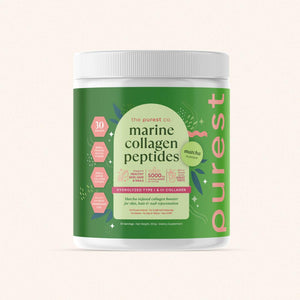
| Skin, in a powder you mix | Marine Collagen Peptides | 5,000 mg marine collagen peptides from wild-caught North Atlantic cod, average size under 3 kDa, 50 mg water bamboo extract, 10 mg beta-carotene | 1 scoop in a glass of water, once a day |
| Joints and bones | Collagen Reforge Mango Swirl | 500 mg chicken collagen Type II, 300 mg red algae extract (calcium and magnesium), 250 mg Terminalia chebula extract | Ready-to-drink sachet, 1 a day |
Product details: The Purest Co product information and product pages.
Collagen Glow Berries is our skin-first pick. Its Wellnex marine collagen dipeptide comes from tilapia and is made by enzymatic hydrolysis, so you get Types I and III, the two main types in your skin, in dipeptide form. Its collagen has a Glycine:Proline:Hydroxyproline amino acid ratio of 3:1:1, and every sachet adds 250 mg vitamin C and 100 mg bilberry extract. It's ready to drink with no water needed: take 1 sachet a day, in the morning or before bed. Collagen Glow Berries and Marine Collagen Peptides are both halal-certified, and both contain fish.
90-day money back guarantee
Related reading: Marine collagen vs plant collagen: what's the difference? · Collagen drink vs capsules: which absorbs better? · Collagen for joints, not just skin · How to read a supplement label in Singapore
Frequently asked questions
Is marine collagen halal?
Fish carries no religious restrictions, but a product's halal status also depends on how it is made, so look for halal certification. Collagen Glow Berries is halal-certified by the Taiwan Halal Integrity Development Association, and Marine Collagen Peptides by JAKIM, Malaysia's Department of Islamic Development.
Can I get enough collagen from food?
Dishes like chicken feet, fish skin and bone soups contain collagen, mostly as gelatin once cooked, but the amount in each serving isn't measured. A supplement gives you a set daily amount of hydrolysed collagen, close to the 2.5 to 10 g a day used in trials.
Can I take a skin collagen and a joint collagen together?
Yes, you can pair a Type I and III collagen for skin with a Type II collagen for joints, as they are made for different goals. Follow the serving on each label, and check with your doctor first if you take prescribed medication or have allergies.
When is the best time to take collagen?
Take it at a time you'll remember every day, because trials measured results after weeks of daily use rather than at a set time of day. Collagen Glow Berries is taken once a day, in the morning or before bed.
Are collagen supplements safe?
A review of 11 randomised trials found collagen supplements generally safe, with no reported adverse events. Check the source for allergens, such as fish in marine collagen, and speak to your doctor first if you are pregnant, breastfeeding or on prescribed medication.
Key takeaways
- For skin, choose hydrolysed collagen peptides with Types I and III; for joints, Type II and collagen peptides have both been studied.
- Skin trials used 2.5 to 10 g of collagen a day, with results in skin hydration, elasticity and collagen density from 4 to 12 weeks.
- Marine, bovine, porcine and chicken collagen differ in their main type, allergens and halal status, so pick the one that suits your diet.
- Choose the format you'll take every day, and check the collagen in mg per serving, not per capsule.
- On the label, look for the dose, type, source, form, vitamin C, sugar, halal certification and allergens.

About the author: Jessie is the Product Manager at The Purest Co. A Biomedical Science graduate from the International Medical University Malaysia, she has over five years in the nutraceutical industry, sourcing high-quality herbs to create supplements that are enjoyable and effective. She keeps up with new research through global conferences.
References
[1] Rahimi N, Launico MV. Biochemistry, collagen synthesis. StatPearls. Updated 18 June 2026.
[2] Varani J et al. Decreased collagen production in chronologically aged skin: roles of age-dependent alteration in fibroblast function and defective mechanical stimulation. Am J Pathol. 2006.
[3] León-López A et al. Hydrolyzed collagen: sources and applications. Molecules. 2019.
[4] de Miranda RB et al. Effects of hydrolyzed collagen supplementation on skin aging: a systematic review and meta-analysis. Int J Dermatol. 2021.
[5] Asserin J et al. The effect of oral collagen peptide supplementation on skin moisture and the dermal collagen network: evidence from an ex vivo model and randomized, placebo-controlled clinical trials. J Cosmet Dermatol. 2015.
[6] Proksch E et al. Oral intake of specific bioactive collagen peptides reduces skin wrinkles and increases dermal matrix synthesis. Skin Pharmacol Physiol. 2014.
[7] Clark KL et al. 24-week study on the use of collagen hydrolysate as a dietary supplement in athletes with activity-related joint pain. Curr Med Res Opin. 2008.
[8] Zdzieblik D et al. Improvement of activity-related knee joint discomfort following supplementation of specific collagen peptides. Appl Physiol Nutr Metab. 2017.
[9] Hexsel D et al. Oral supplementation with specific bioactive collagen peptides improves nail growth and reduces symptoms of brittle nails. J Cosmet Dermatol. 2017.
[10] König D et al. Specific collagen peptides improve bone mineral density and bone markers in postmenopausal women: a randomized controlled study. Nutrients. 2018.
[11] Geahchan S et al. Marine collagen: a promising biomaterial for wound healing, skin anti-aging, and bone regeneration. Mar Drugs. 2022.
[12] De Luca C et al. Skin antiageing and systemic redox effects of supplementation with marine collagen peptides and plant-derived antioxidants: a single-blind case-control clinical study. Oxid Med Cell Longev. 2016.
[13] Majlis Ugama Islam Singapura (MUIS). Halal: for consumers. Accessed 19 October 2026.
[14] Lugo JP et al. Efficacy and tolerability of an undenatured type II collagen supplement in modulating knee osteoarthritis symptoms: a multicenter randomized, double-blind, placebo-controlled study. Nutr J. 2016.
[15] Choi FD et al. Oral collagen supplementation: a systematic review of dermatological applications. J Drugs Dermatol. 2019.
[16] Iwai K et al. Identification of food-derived collagen peptides in human blood after oral ingestion of gelatin hydrolysates. J Agric Food Chem. 2005.
[17] Inoue N et al. Ingestion of bioactive collagen hydrolysates enhance facial skin moisture and elasticity and reduce facial ageing signs in a randomised double-blind placebo-controlled clinical study. J Sci Food Agric. 2016.
[18] Proksch E et al. Oral supplementation of specific collagen peptides has beneficial effects on human skin physiology: a double-blind, placebo-controlled study. Skin Pharmacol Physiol. 2014.
[19] Pullar JM et al. The roles of vitamin C in skin health. Nutrients. 2017.
These statements have not been evaluated by any regulatory authority. This product is not intended to diagnose, treat, cure, or prevent any disease. Individual results may vary. Consult a healthcare provider before use if you are pregnant, breastfeeding, or on prescribed medication.