














 Written by Esther, Production Manager · Updated 11 November 2026
Does kombucha powder have the same benefits as brewed kombucha?
Each format has its own strengths. Brewed kombucha is sweet tea fermented by bacteria and yeasts, so it carries live microbes, organic acids, tea polyphenols, fizz and a little alcohol. Kombucha powder can carry tea and fermentation compounds in a stable, measured form that keeps without a fridge.
This article is for you if: you've seen kombucha powder on an ingredient list and want to know how it compares with the fizzy kombucha in the chiller, from the side of how drinks are actually made.
Kombucha has gone from home brew to supermarket staple, and it now turns up as a powder in drink mixes too. The two look nothing alike, but they start from the same fermented tea. Here's what's in a glass of brewed kombucha, what changes when kombucha is dried, and why we use the powder form in our blends.
→ See Grapefruit & Kombucha Slimming Blend, our citrus drink mix made with kombucha powder
In this article
What's in a glass of brewed kombucha?
Brewed kombucha is a low-alcohol drink made by fermenting sweetened green or black tea with a SCOBY, a symbiotic culture of acetic acid bacteria, lactic acid bacteria and yeasts.[1] The SCOBY forms the jelly-like layer you see floating on top of a home brew.
During fermentation, a lot happens in the jar:[1]
- Yeasts split the sugar into glucose and fructose and turn some of it into alcohol (ethanol) and carbon dioxide, which gives the fizz.
- Acetic acid bacteria turn much of that alcohol into acetic acid, the same acid found in vinegar, and also make glucuronic acid.
- The tea itself brings polyphenols such as catechins, including EGCG in green tea, along with some of its caffeine.[1] [4]
Fermentation runs from 7 to 60 days, or until the brew's acidity reaches about pH 4.2.[1] Because it depends on a living culture, no two batches are quite the same: the microbes in a SCOBY often vary from batch to batch, which makes brewed kombucha hard to standardise.[3]
What happens when kombucha is dried into a powder?
Drying removes the water, the fizz and the need for a fridge. What survives depends on the drying method and the carrier used to protect the cells.
- Freeze-drying vs spray-drying. In a study of kombucha starter cultures, freeze-drying kept 88% to 90% of the bacteria alive, compared with 75% to 79% for spray-drying.[2]
- Heat and carriers. Spray-drying with a maltodextrin carrier showed signs of heat damage to the cells, while gum arabic protected them, so spray-dried and freeze-dried cultures made with gum arabic ended up with similar live counts.[3]
- Stability. Freeze-dried kombucha starter cultures still fermented well after three months of storage at either 30°C or 4°C.[2] That matters in Singapore, where the room you store things in is rarely cool.
- Tea compounds. When researchers dried green tea kombucha into an instant powder, the powder showed good antioxidant activity.[4]
How do brewed kombucha and kombucha powder compare?
Brewed kombucha is the living, fizzy form, while kombucha powder is the stable, measured form. Here's how they line up.
| Brewed kombucha | Kombucha powder | |
|---|---|---|
| How it's made | Sweet tea fermented with a SCOBY for 7 to 60 days | Kombucha or its fermented liquid, dried |
| Live microbes | Acetic acid bacteria, lactic acid bacteria and yeasts | Fewer than before drying; how many survive depends on the method |
| Tea and fermentation compounds | Organic acids such as acetic and glucuronic acid, plus tea polyphenols | Can be kept; one dried kombucha powder showed good antioxidant activity |
| Alcohol and fizz | A little alcohol and natural carbonation from the yeasts | No fizz |
| Consistency | Varies from batch to batch | A measured amount in every serving |
Sources: a review of kombucha's compounds and studies on dried kombucha cultures and powder.[1] [2] [3] [4]
So the two suit different needs. If live cultures are what you're after, a freshly brewed, unpasteurised kombucha is the closer match. If you want a consistent, shelf-stable way to bring kombucha's tangy, fermented-tea character into a daily drink, a powder does that well. Non-living microbes and their components are studied in their own right as postbiotics. For a refresher on the live side, see the difference between prebiotics and probiotics.
Why do we use kombucha powder in our blends?
From a production point of view, a powder is the practical way to put kombucha into a dry drink mix. It can be weighed precisely into every scoop, it mixes evenly with the other ingredients, and the finished blend keeps in a cool, dry cupboard rather than the fridge.
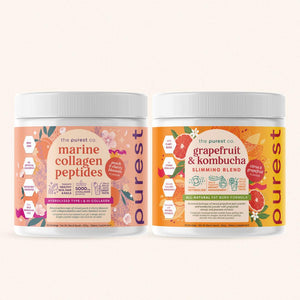
- Grapefruit & Kombucha Slimming Blend contains 50 mg of kombucha powder per 12 g scoop, in a citrus and grapefruit flavour. Have 1 scoop before breakfast or lunch.
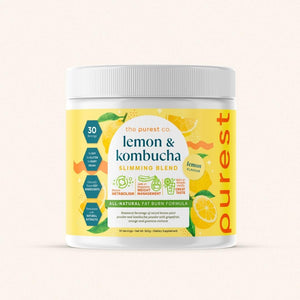
- Lemon & Kombucha Slimming Blend contains 250 mg of kombucha powder per 12 g scoop, in a lemon and kombucha flavour. Have 1 scoop before breakfast or lunch.
Both blends share the same core slimming formula, including 630 mg of grapefruit, orange and guarana extracts; one has a grapefruit juice base and the other a lemon juice base. In both, kombucha powder adds to the flavour. Stir 1 scoop into 300 to 350 ml of water. Each tub holds 30 servings and has a shelf life of 24 months.
Both blends contain grapefruit extracts and natural caffeine. If you take statins, are pregnant or breastfeeding, or take other medication, check with your doctor first.
Shop Grapefruit & Kombucha Slimming Blend
90-day money back guarantee
Related reading: Postbiotics explained · A beginner's guide to prebiotics and probiotics · 5 signs your gut needs attention
Frequently asked questions
Does kombucha powder contain probiotics?
It depends on how it was made. In a study of kombucha starter cultures, freeze-drying kept more bacteria alive than spray-drying. If live cultures matter to you, look for a stated count of live cultures on the label rather than assuming a powder has them.
Does brewed kombucha contain alcohol?
Yes, a little. Yeasts produce alcohol during fermentation and bacteria convert much of it to acids, which is why kombucha is described as a low-alcohol drink. This is worth knowing if you avoid alcohol for health or religious reasons.
How should you store kombucha powder?
Keep it in a cool, dry place, away from direct sunlight. Our two kombucha blends have a shelf life of 24 months, so check the expiry date on the tub. Because they're made with natural ingredients, colour and taste can vary slightly between batches, and a little sediment in your glass is normal.
Who should check with a doctor before drinking kombucha?
Brewed kombucha is made from tea, so it contains some caffeine as well as a little alcohol. Our kombucha blends also contain grapefruit extracts and natural caffeine, about 22 mg per serving in the grapefruit blend. If you're pregnant, breastfeeding, sensitive to caffeine, taking statins or other medication, or managing a health condition, check with your doctor first.
Key takeaways
- Brewed kombucha is sweet tea fermented with bacteria and yeasts, so it carries live microbes, organic acids, tea polyphenols, fizz and a little alcohol.
- Drying kombucha removes the water and fizz; in a study of kombucha starter cultures, freeze-drying kept more bacteria alive than spray-drying.
- Kombucha powder can bring tea and fermentation compounds in a stable, measured form that keeps without a fridge.
- If live cultures matter to you, look for a stated live culture count on the label.
- Our Grapefruit & Kombucha Slimming Blend has 50 mg and our Lemon & Kombucha Slimming Blend has 250 mg of kombucha powder per scoop.

About the author: Esther is the Production Manager at The Purest Co. A biotechnology graduate from Monash University, she has experience in nutraceutical manufacturing and quality assurance, and oversees day-to-day production with a QA-driven approach to quality control, documentation and regulatory compliance.
References
[1] Antolak H, Piechota D, Kucharska A. Kombucha tea: a double power of bioactive compounds from tea and symbiotic culture of bacteria and yeasts (SCOBY). Antioxidants (Basel). 2021.
[2] Phan Van T, Nguyen QD, Nguyen NN, Do AD. Efficiency of freeze- and spray-dried microbial preparation as active dried starter culture in kombucha fermentation. J Sci Food Agric. 2024.
[3] Lima ASL et al. Kombucha fermentation with dried starter cultures: a strategy for microbial stabilization via spray and freeze drying. J Food Sci. 2025.
[4] Sun R et al. Preparation of high polyphenol-low caffeine instant tea powder by exploring and regulating the changes of key functional compounds during kombucha fermentation. Food Chem. 2026.
These statements have not been evaluated by any regulatory authority. This product is not intended to diagnose, treat, cure, or prevent any disease. Individual results may vary. Consult a healthcare provider before use if you are pregnant, breastfeeding, or on prescribed medication.