
















Last reviewed: March 2026 · The Purest Co Editorial Team · About The Purest Co
Is marine collagen better than plant collagen?
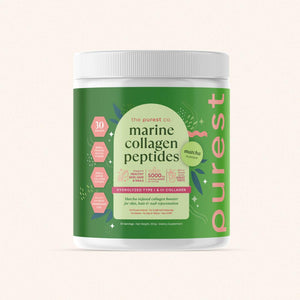
There is no such thing as plant collagen — plants do not produce collagen proteins. Products labelled plant collagen contain ingredients that support the body’s own collagen synthesis. Marine collagen is actual animal-derived collagen protein. For direct supplementation with collagen peptides that stimulate dermal fibroblasts, marine collagen has the clinical evidence.
This article is for you if: You are comparing collagen supplement options and have seen both marine and plant-based collagen products — you want to understand what each actually contains and which has genuine clinical backing for skin outcomes.
Less relevant if: You are already clear on the distinction and are looking for specific brand or dosing guidance.
Plant collagen is one of the most misleading terms in the wellness supplement market. It appears on packaging with confident authority and implies a vegan alternative to animal-derived collagen. The problem is fundamental: plants do not produce collagen. The protein structure of collagen is an animal-specific protein found in connective tissue, skin, bones, and fish scales.
→ See our marine collagen range at The Purest Co
In this article
What Plant Collagen Products Actually Contain
Products marketed as plant collagen typically contain one or more of: vitamin C (required cofactor for collagen synthesis); silica from horsetail or bamboo extract; hyaluronic acid; and various plant polyphenols. These are not collagen — they are collagen synthesis cofactors or supportive compounds.
Marine Collagen: What the Evidence Shows
Marine collagen is derived primarily from fish skin and scales. It is predominantly Type I collagen — the same type that makes up 80 to 90% of human skin collagen. When hydrolysed, marine collagen is absorbed and detected in the dermis within 4 hours of ingestion, where it serves as structural amino acid building blocks and as signalling molecules that upregulate fibroblast activity.[1] The clinical evidence base includes over 20 randomised controlled trials showing significant improvements in skin elasticity, hydration, and dermal density at 5 to 10g daily over 8 to 24 weeks.
Bioavailability: Why Molecular Weight Matters
Unhydrolysed collagen has a molecular weight of approximately 300,000 Daltons — too large for intestinal absorption intact. Hydrolysed collagen peptides at 3,000 to 5,000 Daltons are absorbed as di- and tripeptides. Ultra-hydrolysed peptides below 1,000 Daltons show the highest absorption rates.
Marine vs Bovine Collagen
Bovine collagen is also predominantly Type I and III collagen. Marine collagen has a smaller average peptide size post-hydrolysis (3,000–5,000 Da vs bovine at 5,000–10,000 Da), potentially conferring slightly higher absorption. For Singapore’s Muslim consumers, marine collagen from fish is the natural choice.
What Vegan Options Actually Work
For those who will not use animal-derived supplements: vitamin C at 500mg to 1g daily, silica from bamboo or horsetail, and a diet high in glycine and proline from plant sources including legumes and soy. This supports endogenous collagen production but does not provide the direct fibroblast-stimulating signal that hydrolysed collagen peptides deliver.
Side-by-Side Comparison
| Feature | Marine Collagen | Plant Collagen Products |
|---|---|---|
| Contains actual collagen? | Yes — hydrolysed Type I collagen peptides | No — cofactors and plant extracts only |
| Clinical evidence for skin elasticity? | Yes — 20+ RCTs | Limited |
| Fibroblast stimulation? | Yes — direct peptide signalling | Indirect |
| Suitable for vegans? | No | Typically yes |
| Effective dose | 5 to 10g daily | Varies by ingredient |
Common Mistakes
Buying plant collagen assuming it is a vegan equivalent of marine collagen. It contains no collagen protein. It supports collagen production pathways — that is different from providing collagen itself.
Choosing bovine collagen without checking halal status. For Muslim consumers in Singapore, marine collagen from fish is halal by default.
Frequently Asked Questions
Is there such a thing as plant-based collagen?
No. Plants do not produce collagen. Plant collagen products contain vitamins, minerals, and plant extracts that support the body’s own collagen synthesis pathways.
Which is better, marine or bovine collagen?
Both have strong clinical evidence. Marine has smaller peptide size, potentially higher absorption. Bovine has slightly more evidence for joints. Marine from fish is generally halal.
Is marine collagen suitable for Muslims?
Marine collagen from fish is generally considered halal. Look for products specifying the fish source.
Can vegans take collagen supplements?
No — marine and bovine collagen are animal-derived. The vegan approach is supporting endogenous synthesis with vitamin C, silica, and high plant protein intake.
What type of collagen is best for skin?
Type I collagen, which makes up 80–90% of skin collagen. Both marine and bovine are predominantly Type I.
Do you need vitamin C with collagen?
Yes. Vitamin C is a required enzymatic cofactor. Without it, collagen synthesis is rate-limited regardless of peptide intake.
How much marine collagen should I take per day?
5 to 10g of hydrolysed marine collagen peptides daily. The 10g dose shows the most consistent results.
90-Day Money Back Guarantee
Free shipping on orders above $60
Key Takeaways
- Plant collagen does not exist — plants do not produce collagen protein.
- Marine collagen is Type I hydrolysed collagen with 20+ RCTs showing skin improvements at 5–10g daily.
- Marine collagen from fish is halal by default — the natural choice in Singapore.
- Vitamin C is a required cofactor for collagen synthesis.
- For vegans, supporting endogenous collagen production with vitamin C, silica, and high plant protein is the evidence-based alternative.
References
[1] Proksch E et al. Oral supplementation of specific collagen peptides. Skin Pharmacol Physiol. 2014.
[2] Bolke L et al. A Collagen Supplement Improves Skin Hydration, Elasticity, Roughness, and Density. Nutrients. 2019.
This article is for informational purposes only and is not a substitute for professional medical advice, diagnosis, or treatment.