




















Last reviewed: March 2026 · The Purest Co Editorial Team · About The Purest Co
Should I take collagen or use niacinamide for my skin?
They work at different levels. Niacinamide (vitamin B3) is a topical active working at the epidermal surface: it reduces melanin transfer, strengthens the skin barrier, and reduces sebum. Collagen is an internal supplement working in the dermis: it supports structural density, elasticity, and hydration. Most skin concerns that respond to one do not fully respond to the other. They are complementary, not interchangeable.
This article is for you if: You use niacinamide in your skincare routine and want to know whether adding an internal collagen supplement addresses different things — or whether you are doubling up on the same benefits.
Less relevant if: You have a single very specific concern where one intervention is clearly more targeted.
The niacinamide versus collagen question comes up constantly in Singapore skincare circles. Both are well-researched, both are associated with better-looking skin, and both appear on ‘skin ingredients that actually work’ lists. The confusion is understandable. But once you understand what layer of skin each one targets and through what mechanism, the comparison dissolves — they are not competing for the same job.
→ Explore collagen supplements at The Purest Co
In this article
What Niacinamide Actually Does
Niacinamide is vitamin B3 in its amide form. Applied topically, it is converted inside skin cells to NAD+ and NADP+, coenzymes involved in hundreds of cellular energy reactions. The skin-specific effects with direct clinical evidence include: reduced melanin transfer (blocks the transfer of melanosomes from melanocytes to keratinocytes, reducing pigmentation); skin barrier strengthening (increases ceramide synthesis and reduces trans-epidermal water loss); sebum reduction (measurably reduces sebaceous gland output after 3 to 4 weeks); and anti-inflammatory effects relevant to mild acne and redness.[1] All of these effects are epidermal.
What Oral Collagen Actually Does
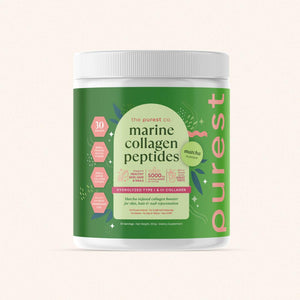
Marine collagen peptides taken orally are hydrolysed to small peptides absorbed through the intestinal wall and delivered to dermal fibroblasts. In fibroblasts, they act as structural building blocks and as signalling molecules that upregulate fibroblast collagen production and hyaluronic acid synthesis. The resulting effects are all dermal: increased skin elasticity, improved skin hydration, and increased dermal density.[2] Collagen supplementation does not affect melanin, sebum, or the epidermal barrier directly.
The Layer Difference: Epidermis vs Dermis
Think of skin as a two-layer system. The epidermis is the top layer: it contains melanocytes, keratinocytes, and the skin barrier. Niacinamide works here. The dermis is the deeper layer: it contains fibroblasts, collagen fibres, elastin, and hyaluronic acid. Collagen supplementation works here. Most visible skin concerns have both an epidermal and a dermal component. Addressing only one layer gives partial results.
Where They Overlap
Both niacinamide and collagen supplementation improve skin hydration — niacinamide by strengthening the barrier and reducing water loss at the surface, collagen by increasing hyaluronic acid production in the dermis. But the mechanism and location are different enough that one does not replace the other. People who use both often report synergistic results in hydration and overall skin quality that exceed what either approach alone produced.
Do You Need Both?
For dark spots and pigmentation: niacinamide is more directly targeted at the mechanism, but collagen improves the skin environment that determines how well pigmentation responds to treatment. For fine lines and elasticity: collagen supplementation is more directly targeted, but niacinamide’s barrier-strengthening effects improve surface texture. For general skin radiance and quality in Singapore, where both barrier compromise and dermal thinning are common, addressing both layers gives the most complete result.
Common Mistakes
Expecting topical niacinamide to replace internal collagen for structural concerns. Topical actives do not penetrate to the dermis in meaningful concentrations. Elasticity and dermal density require internal support that no serum can provide.
Expecting collagen supplements to replace topical actives for pigmentation. Dark spots, uneven skin tone, and PIH have epidermal mechanisms that collagen supplementation does not address. Niacinamide remains the appropriate topical tool.
Frequently Asked Questions
Is niacinamide or collagen better for skin?
They work at different levels and address different concerns. Niacinamide works in the epidermis on pigmentation, barrier function, and sebum. Collagen supplementation works in the dermis on elasticity, density, and hydration. The better answer depends on whether your primary concern is surface texture and pigmentation or structural loss and elasticity.
Can I use niacinamide and take collagen at the same time?
Yes. They work through entirely different mechanisms at different skin layers. There are no known interactions between topical niacinamide and oral collagen supplementation. Using both simultaneously addresses both epidermal and dermal concerns.
Does niacinamide boost collagen?
Modestly. Niacinamide has some evidence for supporting collagen synthesis topically, but its primary evidence-backed benefits are in pigmentation reduction, barrier function, and sebum control rather than structural collagen density.
Does collagen affect skin pigmentation?
Not directly. Collagen supplementation addresses dermal structure. For pigmentation concerns, topical niacinamide, vitamin C, or tranexamic acid are more directly targeted.
What percentage of niacinamide is most effective?
4 to 5% is the practical sweet spot. Most clinical evidence uses 2 to 5%. Higher concentrations (10%+) do not proportionally increase benefit and may cause sensitivity in some skin types.
Can collagen supplements cause breakouts?
No established mechanism exists for marine collagen causing acne. It does not stimulate sebaceous gland activity or contain known acnegenic ingredients.
How long do niacinamide and collagen take to show results?
Niacinamide: measurable pigmentation improvement at 4 to 8 weeks of consistent topical use. Collagen: measurable elasticity and density improvements at 8 to 12 weeks of daily oral supplementation. Both require consistency.
90-Day Money Back Guarantee
Free shipping on orders above $60
Key Takeaways
- Niacinamide works in the epidermis: it reduces melanin transfer, strengthens the skin barrier, and controls sebum.
- Oral collagen works in the dermis: it improves elasticity, density, and hydration by stimulating fibroblast activity.
- They are complementary — addressing surface and structural skin concerns requires different tools.
- Most complete skin improvement strategies address both layers: topical actives for the epidermis, internal supplementation for the dermis.
- There are no interactions between topical niacinamide and oral collagen.
References
[1] Bissett DL et al. Niacinamide: A B vitamin that improves aging facial skin appearance. Dermatol Surg. 2005.
[2] Bolke L et al. A Collagen Supplement Improves Skin Hydration, Elasticity, Roughness, and Density. Nutrients. 2019.
This article is for informational purposes only and is not a substitute for professional medical advice, diagnosis, or treatment. Always consult a qualified healthcare provider with any questions about a medical condition.