















 Written by Jessie, Product Manager · Updated 6 November 2026
How do you choose good marine collagen peptides?
Good marine collagen peptides can improve skin hydration and elasticity: in a placebo-controlled trial, 5 g of marine collagen a day improved both within 8 weeks. To choose one, check the label names the fish and where it comes from, the collagen is hydrolysed, a serving gives about 5 g, sugar is low and heavy metal tests are published.
This article is for you if: you're comparing marine collagen powders, or thinking about our Marine Collagen Peptides or Marine Collagen Peptides Matcha, and want to know what to look for on the label and how ours measure up.
Marine collagen powders can look alike on the shelf, but the label tells them apart: which fish the collagen comes from, how finely it's broken down, how much collagen you get per scoop and what else is in it. This guide explains what marine collagen peptides are, what research shows they do for skin, and the seven things to check before you buy, with our own powders as the worked example.
→ See Marine Collagen Peptides, our marine collagen powder from wild-caught Norwegian cod
In this article
What are marine collagen peptides?
Marine collagen peptides are collagen from fish that has been hydrolysed: broken down by enzymes into short chains called peptides, so the powder dissolves in a glass of water. Fish skin is a common source of type I collagen, the most abundant type of collagen in your body, found mainly in skin and tendons.[1]
Your body takes up hydrolysed collagen as amino acids and small peptides. When healthy volunteers took hydrolysed type I collagen from fish skin or fish scales after a 12-hour fast, collagen peptides appeared in their blood, and prolyl-hydroxyproline (Pro-Hyp), a two-amino-acid piece of collagen, was a major one.[2]
Marine collagen is one of several collagen sources, alongside bovine (cow) and chicken. For collagen types, sources and other formats, see our guide to which type of collagen is best for you.
What do marine collagen peptides do for your skin?
Daily collagen peptides support skin hydration, elasticity and collagen density in the dermis, the deeper layer of skin that gives it strength and bounce. If long days in air-conditioning leave your skin feeling tight, hydration is a good change to watch for. Here's what trials found.
- Hydration, elasticity and wrinkles. A 2021 meta-analysis of 19 randomised, double-blind trials, with 1,125 people aged 20 to 70, found that hydrolysed collagen improved skin hydration, elasticity and wrinkles compared with placebo, after about 90 days of use.[3]
- Collagen density in the dermis. In placebo-controlled trials, collagen peptides increased collagen density in the dermis after 4 weeks, with a less fragmented collagen network, and improved skin hydration after 8 weeks. Both effects lasted to 12 weeks.[4]
- Marine collagen at 5 g a day. In a placebo-controlled trial of 72 women, 5 g of tuna collagen peptides a day for 8 weeks improved skin hydration, elasticity and skin density compared with placebo, and the gains largely held 2 weeks after they stopped.[5] In another, 36 postmenopausal women took 5 g of marine collagen a day, and skin elasticity on their cheeks improved within 4 weeks compared with placebo. The difference was still there 4 weeks after they stopped.[6]
Results build with daily use. For the week-by-week timeline, see how long collagen actually takes to work.
What should you check before you buy marine collagen peptides?
Seven things on the label tell you most of what you need to know: the fish, the peptide size, the collagen per serving, the extras, the sugar, the halal certification and the lab tests.
- The fish and where it comes from. A clear label names the species, says whether it's wild-caught or farmed, and gives the country or ocean. "Marine collagen" alone tells you less. Every marine collagen contains fish, so skip it if you have a fish allergy.
- Hydrolysed, with the peptide size stated. Look for "hydrolysed collagen" or "collagen peptides", and a size in daltons (Da), the unit for the size of a molecule; 1 kDa is 1,000 Da. Hydrolysed collagen is typically 3 to 6 kDa.[7] In a randomised crossover study, collagen that had been further broken down by enzymes raised blood levels of glycine, proline and hydroxyproline, the amino acids collagen is rich in, faster than collagen that hadn't.[8] Small peptides have skin results too: in a 12-week trial, 1,000 mg a day of a low-molecular-weight collagen peptide from fish skin improved skin hydration, wrinkles and elasticity compared with placebo.[9]
- Collagen per serving, compared with the trials. Check the collagen in mg per serving, not the weight of the scoop, because a scoop also holds flavour and other ingredients. Skin trials used 2.5 to 10 g of collagen hydrolysate a day, for 8 to 24 weeks,[10] and two placebo-controlled trials of marine collagen used 5 g a day.[5] [6]
- Extras that each have a job. Vitamin C is a common one: skin holds high levels of vitamin C, which stimulates collagen production.[11] Antioxidants and plant extracts are others. Look for each extra named, with the amount per serving.
- Sugar per serving. Flavoured powders list total sugars on the nutrition panel. Compare the figure per serving, since the per 100 g column looks much higher.
- Halal certification, if you need it. Fish has no religious restrictions as a collagen source,[1] but halal certification also depends on a product's formulation and how each batch is made,[12] so look for a named certifying body.
- Published lab tests. A heavy metal report from an independent laboratory lets you check the results against the limits for health supplements set by Singapore's Health Sciences Authority (HSA): arsenic 5 ppm, cadmium 0.3 ppm, lead 10 ppm and mercury 0.5 ppm (1 ppm is 1 mg per kg).[13] A microbe report checks for bacteria such as E. coli and Salmonella.
How do our Marine Collagen Peptides measure up?
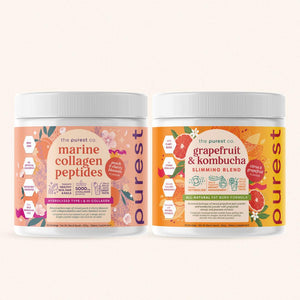
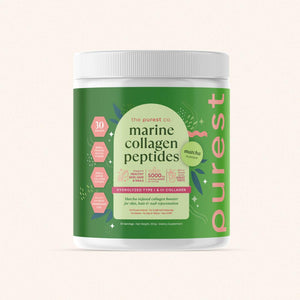
Both of our marine collagen powders give you 5,000 mg of hydrolysed collagen from wild-caught Norwegian cod in every scoop, are halal-certified by JAKIM, and have published lab reports. Here's how they compare on the checklist.
| What to check | Marine Collagen Peptides | Marine Collagen Peptides Matcha |
|---|---|---|
| Fish and origin | Wild-caught cod from Norway, in the North Atlantic | Wild-caught cod from Norway, in the North Atlantic |
| Form and peptide size | Hydrolysed Types I and III collagen, made by enzymatic hydrolysis; average peptide size 500 to 3,000 Da | Hydrolysed Types I and III collagen |
| Collagen per serving | 5,000 mg in a 10 g scoop | 5,000 mg in a 13 g scoop |
| Extras per serving | 50 mg water bamboo extract (Zizania latifolia), 10 mg beta-carotene | 3,000 mg Japanese matcha, a source of catechins such as EGCG; 50 mg water bamboo extract |
| Flavour and how to mix | Peach and cherry blossom; 1 scoop in 300 to 350 ml of water | Matcha; 1 scoop in 150 ml of water |
| Sugar per serving | 1.8 g | 0.7 g |
| Halal | Certified by JAKIM, the Department of Islamic Development Malaysia | Certified by JAKIM, the Department of Islamic Development Malaysia |
| Good to know | Contains fish | Contains fish and milk, and natural caffeine from matcha |
| Published lab tests | Heavy metals, microbes and sugar content | Heavy metals and microbes |
Sources: our product guide, product pages, product information sheets and lab reports, checked 6 November 2026.[12] [14]
Here's what the lab reports show. Both powders were tested by Bio Synergy Laboratories, an independent laboratory in Malaysia.[14]
- Marine Collagen Peptides: none of the 5 heavy metals tested (arsenic, lead, mercury, cadmium and antimony) was detected, and no E. coli, Salmonella, yeast or mould was found. The same report measured total sugar at 17.4 g per 100 g, in line with the 1.8 g per scoop on our label.
- Marine Collagen Peptides Matcha: every heavy metal result sits well within HSA's limits, and the microbe test found no microbial growth.
Both powders are made in a US FDA-registered facility in Malaysia with HACCP and ISO 22000 certification, and we run extra testing in Taiwan and Singapore to screen for commonly found medicines.[12] We chose wild-caught Norwegian cod for full traceability from catch through production, and for a collagen that's clean in taste and smell, which matters when you take it every day. Read more in Talking formulation: Marine Collagen Peptides.
To pick between them, choose Marine Collagen Peptides for a light peach and cherry blossom drink before breakfast or before bed. Choose Marine Collagen Peptides Matcha if you love matcha and like your collagen in the morning or early afternoon. Our product guide has how to take and store each one, and our guide to the best time to take collagen helps you build the habit.
Should you choose a powder or a ready-to-drink collagen?
Choose a powder if you like to mix your own drink, and a ready-to-drink sachet if you'd rather have nothing to mix. Either way, the daily habit is what counts: skin trials gave collagen every day for 8 to 24 weeks.[10]
- Powder: you stir a scoop into water, and you can choose your flavour. Marine Collagen Peptides can also go into juice or a smoothie, and Marine Collagen Peptides Matcha into milk or a smoothie. Each tub holds 30 servings, one a day for a month.
- Ready-to-drink: you tear open a sachet and drink it, with no water or shaker, which is handy at work or when you travel. Our ready-to-drink option is Collagen Glow Berries, with 6,000 mg of Wellnex marine collagen dipeptide (Types I and III, from tilapia) and 250 mg of vitamin C in every sachet. It's halal-certified by the Taiwan Halal Integrity Development Association.
Marine Collagen Peptides gives you 5,000 mg of hydrolysed marine collagen from wild-caught Norwegian cod in every scoop, with water bamboo extract and beta-carotene, and 1.8 g of sugar per serving. It's halal-certified by JAKIM, and the lab reports are published for you to check.
90-day money back guarantee
Related reading: Which type of collagen is best for you? · Talking formulation: Marine Collagen Peptides · How long does collagen actually take to work? · When is the best time to take collagen?
Frequently asked questions
How much marine collagen should I take a day?
Skin trials used 2.5 to 10 g of hydrolysed collagen a day, and two placebo-controlled trials of marine collagen used 5 g a day. One scoop of Marine Collagen Peptides or Marine Collagen Peptides Matcha gives you 5,000 mg, which is 5 g, and the label directions are one scoop a day.
When should I take marine collagen peptides?
Take it at the same time every day, so it becomes a habit. Marine Collagen Peptides is best before breakfast or before bed, mixed into 300 to 350 ml of water. Marine Collagen Peptides Matcha is best in the morning or early afternoon, as matcha naturally contains caffeine.
How long does marine collagen take to work?
In placebo-controlled trials of marine collagen at 5 g a day, skin elasticity improved within 4 weeks, and hydration, elasticity and skin density improved by 8 weeks. With our marine collagen powders, results are best seen after 1 to 2 months of daily use.
Is The Purest Co Marine Collagen Peptides halal?
Yes. Marine Collagen Peptides and Marine Collagen Peptides Matcha are halal-certified by JAKIM, the Department of Islamic Development Malaysia, even if the current packaging doesn't show the halal logo yet. All our products are free from porcine-derived ingredients.
Can I mix marine collagen powder into other drinks?
Yes. Marine Collagen Peptides can go into juice or a smoothie as well as water, and Marine Collagen Peptides Matcha works in milk or a smoothie. For Marine Collagen Peptides, add the powder to your glass first, then the water, as it dissolves better that way.
Key takeaways
- Marine collagen peptides are fish collagen broken down by enzymes into small peptides, and fish skin is a common source of type I collagen, the most abundant type of collagen in your body.
- In placebo-controlled trials, 5 g of marine collagen a day improved skin elasticity within 4 weeks, and hydration, elasticity and skin density within 8 weeks.
- Before you buy, check the fish and where it comes from, the peptide size, the collagen per serving, the extras, the sugar per serving, a named halal certifier and published lab tests.
- Compare any heavy metal report with HSA's limits for health supplements.
- Our Marine Collagen Peptides and Marine Collagen Peptides Matcha each give 5,000 mg of collagen from wild-caught Norwegian cod per scoop, are halal-certified by JAKIM and have published lab reports.
- Prefer nothing to mix? Collagen Glow Berries is our ready-to-drink marine collagen.

About the author: Jessie is the Product Manager at The Purest Co. A Biomedical Science graduate from the International Medical University Malaysia, she has over five years in the nutraceutical industry, sourcing high-quality herbs to create supplements that are enjoyable and effective. She keeps up with new research through global conferences.
References
[1] Geahchan S, Baharlouei P, Rahman A. Marine collagen: a promising biomaterial for wound healing, skin anti-aging, and bone regeneration. Mar Drugs. 2022.
[2] Ohara H et al. Comparison of quantity and structures of hydroxyproline-containing peptides in human blood after oral ingestion of gelatin hydrolysates from different sources. J Agric Food Chem. 2007.
[3] de Miranda RB, Weimer P, Rossi RC. Effects of hydrolyzed collagen supplementation on skin aging: a systematic review and meta-analysis. Int J Dermatol. 2021.
[4] Asserin J et al. The effect of oral collagen peptide supplementation on skin moisture and the dermal collagen network: evidence from an ex vivo model and randomized, placebo-controlled clinical trials. J Cosmet Dermatol. 2015.
[5] Morakul B et al. The evidence from in vitro primary fibroblasts and a randomized, double-blind, placebo-controlled clinical trial of tuna collagen peptides intake on skin health. J Cosmet Dermatol. 2024.
[6] Sangsuwan W, Asawanonda P. Four-weeks daily intake of oral collagen hydrolysate results in improved skin elasticity, especially in sun-exposed areas: a randomized, double-blind, placebo-controlled trial. J Dermatolog Treat. 2021.
[7] León-López A et al. Hydrolyzed collagen: sources and applications. Molecules. 2019.
[8] Skov K et al. Enzymatic hydrolysis of a collagen hydrolysate enhances postprandial absorption rate: a randomized controlled trial. Nutrients. 2019.
[9] Kim DU et al. Oral intake of low-molecular-weight collagen peptide improves hydration, elasticity, and wrinkling in human skin: a randomized, double-blind, placebo-controlled study. Nutrients. 2018.
[10] Choi FD et al. Oral collagen supplementation: a systematic review of dermatological applications. J Drugs Dermatol. 2019.
[11] Pullar JM, Carr AC, Vissers MCM. The roles of vitamin C in skin health. Nutrients. 2017.
[12] The Purest Co. Help Center: halal-certified products, collagen peptide size, certified manufacturing and extra testing.
[13] Health Sciences Authority. Health supplements: overview, toxic heavy metal limits. Last updated 30 October 2026.
[14] The Purest Co. Lab tests: published heavy metal, microbe and sugar content reports for Marine Collagen Peptides and Marine Collagen Peptides Matcha.
These statements have not been evaluated by any regulatory authority. This product is not intended to diagnose, treat, cure, or prevent any disease. Individual results may vary. Consult a healthcare provider before use if you are pregnant, breastfeeding, or on prescribed medication.