







![[Pre-Order] Joint Pre+Probiotic Melts](http://thepurest.co/cdn/shop/files/1_af310510-f2f3-4ee7-91c6-0c9314c437ab_300x.jpg?v=1755068216)













Last reviewed: March 2026 · The Purest Co Editorial Team · About The Purest Co
Does collagen help joint pain?
Yes. Multiple randomised controlled trials show significant reductions in joint pain and improvements in mobility with consistent hydrolysed collagen supplementation at 5g to 15g per day over 12 to 24 weeks. The mechanism is well-understood: collagen peptides accumulate in cartilage and stimulate chondrocytes to increase collagen and proteoglycan production.
Joint pain and stiffness are so common after 35 that most people accept them as inevitable. Knees that protest on stairs. Hips that ache after sitting too long. Wrists that click when you turn them. The standard advice is exercise more, maintain a healthy weight, and consider anti-inflammatories when it gets bad. What's less commonly offered: targeted collagen supplementation has a growing body of evidence for slowing and partially reversing the cartilage degradation that drives joint pain.
This isn't a marginal effect. Multiple randomised controlled trials show significant reductions in joint pain and improvements in mobility with consistent hydrolysed collagen supplementation. Here's what the science actually supports and why it works.
Shop Collagen Reforge for active recovery and joint support
What's Actually Happening in Joint Pain
Cartilage is the smooth connective tissue covering the ends of bones at joints. It acts as a shock absorber and allows bones to glide against each other without friction. Cartilage is primarily composed of Type II collagen and proteoglycans, and it has no blood supply, which means it relies on mechanical loading (the compression and release of joint movement) to receive nutrients from the synovial fluid around it.
As collagen production declines from the mid-20s, the cartilage matrix gradually loses structural integrity. Collagen fibres become less organised, proteoglycan content drops, and the cartilage becomes thinner and less able to absorb impact. The result is the familiar constellation of joint pain, stiffness, and inflammation that characterises osteoarthritis and general joint wear.
The synovial membrane that produces joint-lubricating fluid is also primarily collagen-based, and its function declines alongside cartilage quality. The combination of degraded cartilage and reduced synovial fluid quality is what produces the grinding sensation and inflammation of advanced joint wear.
How Collagen Supplementation Supports Joint Health
Hydrolysed collagen peptides support joint health through a mechanism that's now well-understood. When collagen peptides are absorbed intact into the bloodstream, they accumulate preferentially in cartilage tissue. Here they act as biological signals to chondrocytes, the cells responsible for producing and maintaining cartilage, stimulating them to increase collagen synthesis and proteoglycan production.
This is the same fibroblast-stimulating mechanism that underlies collagen's skin benefits, applied to cartilage rather than dermal tissue. The key difference is that chondrocytes have even slower turnover than skin fibroblasts, which is why joint outcomes take longer to appear (typically 12 to 24 weeks rather than 8 to 12 for skin) but can be meaningfully sustained with consistent supplementation.[1]
What the Clinical Evidence Shows
The evidence for collagen and joint outcomes is stronger than many clinicians realise. A landmark 2008 study published in Current Medical Research and Opinion followed 147 athletes with activity-related joint pain and found that hydrolysed collagen supplementation produced significant reductions in joint pain at rest, during activity, and when carrying objects compared to placebo over 24 weeks.
A 2017 review in the British Journal of Sports Medicine analysed multiple trials on collagen supplementation for musculoskeletal injuries and found consistent evidence for improvements in joint pain and function, particularly for exercise-related joint stress. The review specifically noted that collagen peptides taken with vitamin C before exercise produced the most significant connective tissue benefits, a finding subsequently replicated in further research.[2]
Type I vs Type II Collagen for Joints
Most consumer collagen supplements use Type I collagen (from marine or bovine hide), which is the primary structural collagen in skin, tendons, and ligaments. Type II collagen is the primary collagen in cartilage specifically and has been more specifically studied for osteoarthritis outcomes.
For general joint and connective tissue support (tendons, ligaments, general joint comfort), Type I hydrolysed collagen at adequate doses produces meaningful benefits. For people with cartilage-specific concerns (osteoarthritis, cartilage wear from high-impact sport), Type II collagen or undenatured Type II collagen (UC-II) has more targeted evidence. Many comprehensive joint formulations combine both types.
The Vitamin C Timing Protocol
One of the most practically useful findings in connective tissue collagen research is the timing effect. A 2017 study specifically designed to test this found that taking hydrolysed collagen with vitamin C approximately 60 minutes before exercise produced significantly greater connective tissue collagen synthesis (measured in tendon biopsies) compared to taking it at other times or without vitamin C.
The mechanism is: vitamin C is required as a cofactor for collagen cross-linking. The exercise creates demand for connective tissue repair. The collagen peptides provide the substrate. The combination of all three simultaneously produces the optimal anabolic environment for connective tissue collagen production. For people with exercise-related joint issues or those trying to prevent them, this protocol is one of the most evidence-backed supplementation approaches in sports nutrition.
| Concern | Recommended Type | Minimum Dose | Key Timing |
|---|---|---|---|
| General joint comfort | Hydrolysed Type I | 5g per day | Daily, with Vitamin C |
| Cartilage wear / OA | Type II / Undenatured Type II | 5g+ per day | Daily, consistent |
| Tendon / ligament repair | Hydrolysed Type I + III | 5g per day | 60 min pre-exercise |
| Skin + joint combined | Marine Type I hydrolysed | 2.5–5g per day | Daily with Vitamin C |
The Purest Co Range for Joint Support
Collagen Reforge Mango Swirl is specifically formulated for active recovery and connective tissue support, combining hydrolysed collagen with actives targeting structural repair. Designed for daily use around exercise sessions.
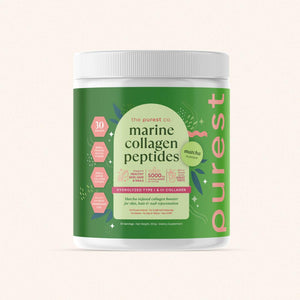
Marine Collagen Peptides provides high-dose hydrolysed marine collagen at levels consistent with clinical research on joint and connective tissue outcomes.
Joint Pre+Probiotic Melts addresses the gut health foundation for joint outcomes, as systemic inflammation from gut dysbiosis directly amplifies joint inflammatory responses, combining probiotic strains with joint-specific support actives.
Frequently Asked Questions
Does collagen help joint pain?
Yes. Multiple randomised controlled trials show significant reductions in joint pain and improvements in joint function with consistent hydrolysed collagen supplementation. The mechanism is well-understood: collagen peptides accumulate in cartilage tissue and stimulate chondrocytes to increase collagen and proteoglycan production, directly supporting cartilage quality.
How much collagen should I take for joints?
The clinical evidence for joint outcomes uses doses at the higher end of the therapeutic range: typically 5g to 15g of hydrolysed collagen per day. This is higher than the 2.5g minimum shown effective for skin outcomes. Products underdosed for skin will be even more underdosed for joint outcomes.
How long does collagen take to work for joint pain?
Joint outcomes take longer than skin outcomes because chondrocytes have slower turnover rates. Most clinical trials showing significant joint pain reduction run for 12 to 24 weeks of consistent daily supplementation. Expecting significant joint changes at 6 to 8 weeks is unrealistic based on the biology involved.
What is the best collagen for joints in Singapore?
Look for hydrolysed collagen at 5g or more per serving, ideally combined with vitamin C which is required for collagen cross-linking. Taking it approximately 60 minutes before exercise produces better connective tissue outcomes than other timing. The Purest Co Collagen Reforge is formulated specifically for active recovery and connective tissue support.
Can gut health affect joints?
Yes. Systemic inflammation from gut dysbiosis directly amplifies joint inflammatory responses, making joint pain more severe and recovery slower. Addressing gut microbiome health reduces the inflammatory load affecting joints. This is why some people with joint pain find improvements from gut health interventions even without specific joint supplements.
Is collagen good for knee pain?
Yes, specifically for knee pain associated with cartilage wear and osteoarthritis. Hydrolysed collagen peptides accumulate in cartilage tissue and stimulate chondrocytes to increase collagen and proteoglycan production in the cartilage matrix. Multiple RCTs show significant reductions in knee pain and improvements in mobility with consistent hydrolysed collagen at 5g to 15g per day over 12 to 24 weeks. The effect is more pronounced in people with established cartilage wear than in those with purely structural inflammation.
What is the best collagen for joint pain in Singapore?
Look for hydrolysed collagen at 5g or more per serving with vitamin C included or supplemented separately. Taking it approximately 60 minutes before exercise produces the best connective tissue synthesis outcomes. For cartilage-specific concerns like osteoarthritis, Type II collagen or undenatured Type II (UC-II) has more targeted evidence. The Purest Co Collagen Reforge is formulated for active recovery and connective tissue support.
How long should I take collagen for joint pain?
Cartilage and tendon have slower cell turnover than skin, so joint outcomes require longer supplementation periods. Most clinical trials showing significant joint pain reduction run for 12 to 24 weeks of consistent daily use. Stopping collagen once joint pain improves will lead to gradual return of symptoms over months as the fibroblast-stimulating effect dissipates. For ongoing joint health, daily supplementation at maintenance doses is the most evidence-consistent approach.
References
[1] Clark KL et al. Current Medical Research and Opinion. 2008. 24-week study on the use of collagen hydrolysate as a dietary supplement in athletes with activity-related joint pain.
[2] Shaw G et al. American Journal of Clinical Nutrition. 2017. Vitamin C-enriched gelatin supplementation before intermittent activity augments collagen synthesis.
[3] Zhu Z et al. Nutrients. 2023;15(14):3123. The role of probiotics in skin health and related gut-skin axis: a review.
This article is for informational purposes only and is not a substitute for professional medical advice, diagnosis, or treatment. Always consult a qualified healthcare provider with any questions about a medical condition.