







![[Pre-Order] Joint Pre+Probiotic Melts](http://thepurest.co/cdn/shop/files/1_af310510-f2f3-4ee7-91c6-0c9314c437ab_300x.jpg?v=1755068216)















The short answer: Digital eye strain comes mostly from reduced blinking, sustained close focus and dry air — not from blue light itself. Environmental fixes help most. Recent trials suggest lutein and zeaxanthin may measurably improve tear film stability and glare recovery in heavy screen users, over a couple of months.
What's actually happening to your eyes at a screen?
Three things at once, and none of them is what the blue-light marketing suggests.
You stop blinking properly. This is the big one. Normal blink rate drops substantially during concentrated screen work, and the blinks you do manage are often incomplete — the lid doesn't fully close. Blinking is what spreads the tear film. Fewer, shallower blinks means the tear film breaks up and the surface dries.
Your focusing muscles hold one position for hours. The ciliary muscle contracts to focus up close and stays contracted. It's a sustained isometric hold, and like any muscle held in one position, it aches.
The air is working against you. Air-conditioning is drying by design, and in Singapore most of us are in it all day. Ceiling vents blowing across a desk make it considerably worse.
Blue light, meanwhile, has turned out to be a much smaller factor for eye strain than the product category implies. Where screen light does matter reliably is in evening light exposure affecting sleep timing — a genuine effect, but a different problem.
What helps most, and costs nothing?
The 20-20-20 rule. Every 20 minutes, look at something roughly 20 feet away for 20 seconds. It lets the focusing muscle relax and prompts a few proper blinks. It works because it's frequent, not because the numbers are precise.
Blink deliberately, fully. Sounds absurd; helps a surprising amount. A few slow, complete blinks each time you look away resets the tear film.
Get the screen right. Slightly below eye level, an arm's length away. Looking slightly downward means less of the eye surface is exposed, which reduces evaporation — a genuinely underrated fix.
Redirect the vents. Not having cold air blowing across your face is one of the most effective things you can do about office dry eye.
Sort the ambient lighting. A bright screen in a dark room, or a window glaring behind your monitor, both force your eyes to work harder.
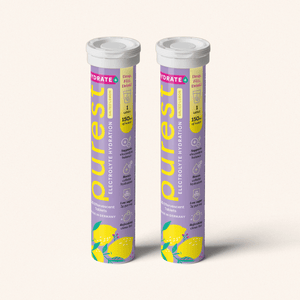
Stay hydrated. Tear film production is affected by overall hydration status, and desk dehydration is easy to drift into. Hydrate+ Electrolyte Hydration Tablets can help if plain water isn't happening.
Do lutein and zeaxanthin supplements do anything?
There's more here than we expected, with real limits.
Lutein and zeaxanthin are carotenoids that concentrate in the macula, where they act as a natural blue-light filter and as antioxidants. That's established. The question is whether supplementing changes anything you'd notice.
A 2025 randomised, double-blind, placebo-controlled study followed 70 volunteers aged 18–65 who used screens for more than six hours daily, giving them 10mg lutein plus 2mg zeaxanthin isomers or placebo. Compared with placebo, the supplemented group showed greater improvements in the Schirmer tear test, tear film break-up time, and photostress recovery.
Here's the part worth reading carefully: there were no between-group differences in self-reported measures. The objective tear-film and glare-recovery markers improved; how people said their eyes felt did not differ measurably. That's an honest mixed result, and separate research indicates it takes roughly 8–12 weeks of consistent intake to raise macular pigment density at all.
If you'd like to try it, our Eye Essentials Lemon Bursties are built around this territory, and Omega-3 Mango Burstlets cover omega-3s, which also have some data around tear stability. Our honest expectation-setting: think of these as a slow, modest addition to the environmental fixes above — which remain the bigger lever — and give them at least two to three months before drawing conclusions.
Frequently asked questions
Do blue light glasses work for eye strain? The evidence for reducing digital eye strain specifically is weak. If they help you, that's worth something — but the blinking and distance fixes have far better support and are free.
Can screens permanently damage my eyes? Current evidence doesn't support permanent damage from normal screen use in adults. The strain and dryness are real but generally reversible. Screen time in childhood and myopia progression is a genuinely separate and more concerning question.
When should I see an eye doctor? Persistent dryness that drops don't touch, blurred vision that doesn't clear when you look away, eye pain, sudden floaters or flashes, or headaches that keep recurring. Also worth booking if you haven't had your prescription checked in a couple of years — uncorrected vision is a common hidden cause of eye strain.
This article is general education, not medical advice — please see an optometrist or ophthalmologist about persistent eye symptoms.