


![[Pre-Order] Night Burn Saffron Elixir](http://thepurest.co/cdn/shop/files/NBSE-WebsitePDP_Tier1_1_1_300x.png?v=1786005812)


















![[Pre-Order] Night Burn Saffron Elixir](http://thepurest.co/cdn/shop/files/NBSE-WebsitePDP_Tier1_1_1_1080x.png?v=1786005812)




 Written by Jessie, Product Manager · Updated 22 October 2026
Does collagen help with joint pain?
Yes, collagen may help. In trials, active adults who took 5 to 10 g of collagen peptides a day had less activity-related joint and knee pain than those on placebo after 12 to 24 weeks. In knee osteoarthritis, collagen lowered pain and stiffness scores. Daily use over weeks is what builds the benefit.
This article is for you if: your knees complain on the MRT stairs, after a run or a long day on your feet, and you want to know whether collagen is worth adding, which type to choose, how much to take and how long to give it.
Most people think of collagen as a skin supplement. Your joints are built from it too. Cartilage, the smooth cushion at the ends of your bones, and the tendons and ligaments that hold a joint together are all rich in collagen. Clinical trials have now tested collagen supplements in athletes, in active adults with sore knees and in people with knee osteoarthritis. Here's what they found, and how to put it to work in your own routine.
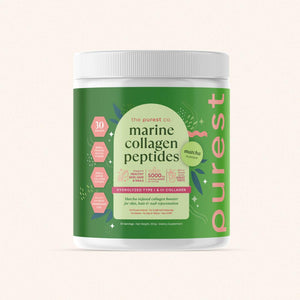
→ See Marine Collagen Peptides, our 5,000 mg marine collagen powder
In this article
What did trials find about collagen and joint pain?
In randomised, placebo-controlled trials, people who took collagen peptides every day had less joint pain during and after activity than people who took a placebo. Collagen peptides, also called hydrolysed collagen, are collagen already cut into short chains of amino acids so your body can absorb them easily.
- Athletes, 24 weeks: 147 varsity and club athletes took 10 g of collagen hydrolysate or a placebo every day. The collagen group reported less joint pain when walking, standing, resting, carrying objects and lifting, and a doctor's assessment of pain at rest agreed.[2]
- Active adults with sore knees, 12 weeks: 139 athletic adults with knee discomfort during sport took 5 g of specific collagen peptides or a placebo every day. Pain during activity eased more with collagen, confirmed by their doctors, and they relied less on other options to manage their knees.[1]
- Knee osteoarthritis, pooled trials: a 2019 meta-analysis of randomised, placebo-controlled trials found that collagen lowered total WOMAC scores (a standard questionnaire on knee pain, stiffness and function), stiffness scores and pain scores on a visual scale.[3]
The common thread is a daily dose taken for weeks. That's the habit to aim for.
Does collagen help knee pain?
Yes, the knee is where collagen has been studied most, and trials found less knee pain and better knee comfort with daily collagen. That holds for active people whose knees ache with sport and for people with knee osteoarthritis, the wear-related condition where cartilage thins over time.
- Collagen peptides for sporty knees: 5 g a day for 12 weeks eased activity-related knee pain in 139 athletic adults.[1] In the 24-week athletes' trial, the benefit was even clearer in the 63 athletes whose pain was in the knee.[2]
- Collagen peptides for knee osteoarthritis: in a trial of 250 people with knee osteoarthritis, 10 g of collagen hydrolysate a day for 6 months significantly improved knee comfort on pain scales.[4]
- Undenatured type II collagen: this is a different form, taken in milligrams rather than grams. In 191 people with knee osteoarthritis, 40 mg a day for 180 days lowered total WOMAC scores more than placebo and more than glucosamine with chondroitin, with gains in pain, stiffness and physical function.[5] In 55 healthy adults whose knees ached after exercise, the same dose for 120 days improved how far they could straighten the knee, and they could exercise longer before discomfort set in.[6]
If your knees ache in your 40s alongside other changes, hormones may play a part too. Read our guide to why joints ache in perimenopause.
How does collagen reach your joints?
Collagen peptides are absorbed through the gut and, in lab and animal studies, gathered in cartilage, where they encouraged cartilage cells to make more collagen. Cartilage is the firm, smooth tissue that covers the ends of bones in a joint and absorbs impact. It's made mostly of type II collagen and has no blood supply of its own.
- They reach cartilage: in mice, 95% of a labelled collagen hydrolysate was absorbed within 12 hours. It then built up in cartilage, where levels were more than twice as high as with labelled proline, a single amino acid, and stayed there for a long time.[7]
- They signal cartilage cells: chondrocytes are the cells that build and maintain cartilage. In a cell study, collagen hydrolysate increased their type II collagen production in step with the dose, while intact collagen and a wheat protein hydrolysate did not.[8]
- Vitamin C completes the picture: your body uses vitamin C to make collagen.[10] Local favourites like guava, papaya and oranges are easy sources.
So collagen peptides work as building blocks and as signals. That's why a steady daily intake matters more than a big dose now and then.
What is the best joint supplement in Singapore?
The best joint supplement is one with a dose that trials have tested, in a form you'll take every day for at least 12 weeks. Collagen peptides have the broadest research for everyday joint and knee comfort, and other ingredients work in different ways. Here's how the main options compare.
| Option | What it is | Dose studied | What trials found |
|---|---|---|---|
| Collagen peptides (hydrolysed collagen) | Collagen cut into short, easily absorbed peptides, from fish, cow or pig | 5 to 10 g a day for 12 to 24 weeks | Less activity-related joint and knee pain in athletes,[1] [2] better knee comfort in knee osteoarthritis[4] and lower pain and stiffness scores across trials[3] |
| Undenatured type II collagen | Type II collagen from chicken sternum cartilage, kept in its native form | 40 mg a day for 120 to 180 days | Lower WOMAC scores in knee osteoarthritis[5] and better knee extension in active adults[6] |
| Glucosamine with chondroitin | Two compounds found naturally in cartilage, usually taken together | 1,500 mg glucosamine and 1,200 mg chondroitin a day | Studied alongside undenatured type II collagen in a 180-day knee osteoarthritis trial, where undenatured type II collagen lowered total WOMAC scores more[5] |
| Oral hyaluronic acid (sodium hyaluronate) | The lubricating molecule found in its highest concentration in joint fluid | 111 mg a day for 12 weeks | Lower combined knee pain, stiffness and discomfort scores than placebo in 31 healthy adults[11] |
Collagen peptide trials and meta-analysis.[1] [2] [3] [4] Undenatured type II collagen trials.[5] [6] Oral hyaluronic acid trial.[11]
When you compare products, check four things:
- The dose per serving: collagen peptide trials used 5 to 10 g a day, so look for a serving in that range.
- The form: hydrolysed collagen, also sold as collagen peptides, is the form tested at gram doses.
- A format you'll keep: a powder, drink or sachet you'll take every day beats a stronger product you forget.
- Allergens: marine collagen contains fish, and some joint products contain milk.
For more on how collagen sources and types differ, read our guide to collagen types and how to choose one. If you'd like a joint routine built around hyaluronic acid and gut health instead, Joint Pre+Probiotic Melts combine rooster comb extract, a natural source of sodium hyaluronate, with 20 billion CFU of three probiotic strains (Pediococcus pentosaceus, Lactobacillus plantarum and Clostridium butyricum) and prebiotics, in one sachet a day. It contains milk.
How much collagen should you take for joints, and for how long?
Take 5 to 10 g of collagen peptides every day and give it at least 12 weeks. The joint trials ran for 12 to 24 weeks, so this is a habit measured in months.[1] [2]
- Dose: 5 g a day eased knee pain in active adults,[1] and 10 g a day was used in athletes and in knee osteoarthritis.[2] [4]
- Duration: plan for 12 weeks before you judge, and keep going after that. The longest trials ran for 6 months.[2] [4]
- Timing: any time you'll keep every day works. If you train, a dose about an hour before exercise is a good option: in 8 healthy men, 15 g of vitamin C-enriched gelatin, a form of collagen, taken 1 hour before 6 minutes of rope skipping doubled a blood marker of new collagen production.[9]
For morning, night and workout options in detail, read our guide to the best time to take collagen.
Marine Collagen Peptides gives you 5,000 mg of marine collagen peptides in one scoop, the same daily amount as the 12-week knee trial.[1] The collagen comes from wild-caught cod from the North Atlantic, sourced from Norway, and is broken down to an average molecular size under 3 kDa so your body can absorb it easily. Each scoop also has 50 mg of water bamboo extract and 10 mg of beta-carotene, in a peach and cherry blossom flavour. Mix one scoop a day into a glass of room temperature or cold water, ideally before breakfast or before bed. It contains fish, so skip it if you have a fish allergy.
90-day money back guarantee
Who notices the biggest difference?
In the trials, people with sore knees, people who train and people whose joints were most worn tended to benefit most. That makes collagen a good fit for anyone whose knees take a daily load.
- People with knee pain: among athletes, the effect was strongest in those whose pain was in the knee.[2]
- People with more joint wear: in the 250-person knee osteoarthritis trial, those with the greatest joint deterioration benefited most.[4]
- People who eat little meat: in the same trial, those with the lowest meat protein intake also benefited most.[4]
- Active people: both athlete trials recruited people who play sport regularly, from varsity and club teams to active young adults.[1] [2]
Collagen works best as part of a joint-friendly routine: regular movement, strength work for the muscles around your knees, and a doctor's advice for pain that is sharp, swollen or getting worse.
Related reading: When is the best time to take collagen? · Why do joints ache in perimenopause?
Frequently asked questions
Is marine or bovine collagen better for joints?
Both supply collagen peptides your body can absorb and use. What the joint trials have in common is a daily dose of hydrolysed collagen taken for weeks, so choose the source that suits your diet. Marine collagen suits people who avoid beef or pork, but it contains fish.
Is it safe to take collagen every day?
Collagen is a food protein, and daily collagen was well tolerated in the joint trials, including 6 months of daily use in people with knee osteoarthritis. Marine Collagen Peptides contains fish, so avoid it if you have a fish allergy. If you're pregnant, breastfeeding, on medication or have allergies, check with your doctor first.
Can I take collagen if I have knee osteoarthritis?
Yes, many people take collagen as daily support alongside the care their doctor recommends. Trials in people with knee osteoarthritis found better knee comfort and lower pain and stiffness scores with daily collagen. Keep up any treatment and exercises your doctor or physiotherapist has given you.
Will collagen for my joints help my skin too?
Collagen is a main structural protein in both skin and joints, so one daily habit can support both. Marine Collagen Peptides was formulated with skin, hair and nails in mind as well, with 50 mg of water bamboo extract and 10 mg of beta-carotene in every scoop. One scoop a day covers both.
Key takeaways
- In trials, 5 to 10 g of collagen peptides a day eased activity-related joint and knee pain within 12 to 24 weeks.
- In knee osteoarthritis, collagen lowered pain and stiffness scores, and 10 g a day for 6 months improved knee comfort.
- Undenatured type II collagen works at 40 mg a day and improved knee scores over 120 to 180 days.
- Collagen peptides reach cartilage and signal cartilage cells to make collagen, so daily use matters most.
- Take it every day for at least 12 weeks, at a time you'll keep, and pair it with vitamin C-rich food.

About the author: Jessie is the Product Manager at The Purest Co. A Biomedical Science graduate from the International Medical University Malaysia, she has over five years in the nutraceutical industry, sourcing high-quality herbs to create supplements that are enjoyable and effective. She keeps up with new research through global conferences.
References
[1] Zdzieblik D et al. Improvement of activity-related knee joint discomfort following supplementation of specific collagen peptides. Appl Physiol Nutr Metab. 2017.
[2] Clark KL et al. 24-Week study on the use of collagen hydrolysate as a dietary supplement in athletes with activity-related joint pain. Curr Med Res Opin. 2008.
[3] García-Coronado JM et al. Effect of collagen supplementation on osteoarthritis symptoms: a meta-analysis of randomized placebo-controlled trials. Int Orthop. 2019.
[4] Benito-Ruiz P et al. A randomized controlled trial on the efficacy and safety of a food ingredient, collagen hydrolysate, for improving joint comfort. Int J Food Sci Nutr. 2009.
[5] Lugo JP et al. Efficacy and tolerability of an undenatured type II collagen supplement in modulating knee osteoarthritis symptoms: a multicenter randomized, double-blind, placebo-controlled study. Nutr J. 2016.
[6] Lugo JP et al. Undenatured type II collagen for joint support: a randomized, double-blind, placebo-controlled study in healthy volunteers. J Int Soc Sports Nutr. 2013.
[7] Oesser S et al. Oral administration of (14)C labeled gelatin hydrolysate leads to an accumulation of radioactivity in cartilage of mice (C57/BL). J Nutr. 1999.
[8] Oesser S, Seifert J. Stimulation of type II collagen biosynthesis and secretion in bovine chondrocytes cultured with degraded collagen. Cell Tissue Res. 2003.
[9] Shaw G et al. Vitamin C-enriched gelatin supplementation before intermittent activity augments collagen synthesis. Am J Clin Nutr. 2017.
[10] Pullar JM et al. The roles of vitamin C in skin health. Nutrients. 2017.
[11] Sugiyama K et al. Oral sodium hyaluronate relieves knee discomfort: a 12-week double-blinded, placebo-controlled study. Exp Ther Med. 2024.
These statements have not been evaluated by any regulatory authority. This product is not intended to diagnose, treat, cure, or prevent any disease. Individual results may vary. Consult a healthcare provider before use if you are pregnant, breastfeeding, or on prescribed medication.